What Should You Do After 6 or 12 Months of Trying to Conceive Without Success?
A Scientific Guide to Infertility Evaluation for Couples
In the previous article, we explained when a couple is considered medically in need of fertility evaluation:
- If the woman is under 35 and pregnancy has not occurred after 12 months of regular, unprotected intercourse
- If the woman is 35 or older and pregnancy has not occurred after 6 months
- If the woman is 40 or older, immediate evaluation is recommended
(If you have not read the previous article, we recommend reading it first.)
Now the important question is:
When you reach this time window and pregnancy still has not occurred, what should be the next step?
Step One: Evaluate Both Partners at the Same Time
One of the biggest misconceptions is that fertility testing should focus only on the woman.
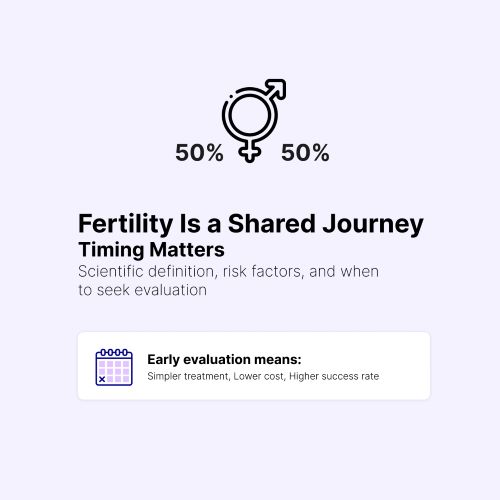
However, according to reliable international sources such as the American Society for Reproductive Medicine (ASRM) and the World Health Organization (WHO), about 40–50% of infertility cases involve male factors.
Fertility is a shared journey.
Therefore, the evaluation process should begin for both partners simultaneously.
Initial Evaluation for Women
1️⃣ AMH Test (Anti-Müllerian Hormone)
This test helps estimate the ovarian reserve, meaning the remaining quantity of eggs in the ovaries.
A low AMH level does not necessarily mean pregnancy is impossible, but it helps physicians choose the most appropriate treatment approach.
Scientific references:
- ASRM Committee Opinion – Fertility Evaluation
- ACOG Practice Guidelines
2️⃣ Hormonal Blood Tests
Depending on the individual situation, doctors may recommend tests such as:
- FSH
- LH
- Estradiol
- TSH
- Prolactin
- Androgen profile (if PCOS is suspected)
Important note:
These tests should be ordered by a specialist based on medical indication, not performed randomly or without guidance.
3️⃣ Transvaginal Ultrasound
This imaging test helps evaluate:
- Ovarian condition
- Presence of cysts or signs of PCOS
- Endometrial thickness
- Initial uterine evaluation
If needed, additional diagnostic procedures may be recommended, such as:
- HSG (Hysterosalpingography) to check whether the fallopian tubes are open
- Advanced pelvic ultrasound
- Hysteroscopy
Initial Evaluation for Men
1️⃣ Semen Analysis
This is the most important first test for men.
The following parameters are evaluated:
- Sperm count
- Motility
- Morphology
- Semen volume
According to the AUA/ASRM Male Infertility Guidelines, semen analysis should be performed at the very beginning of fertility evaluation.
2️⃣ Hormonal Tests (If Needed)
If abnormalities appear in the semen analysis, additional tests may be recommended such as:
- Testosterone
- FSH
- LH
3️⃣ Testicular Ultrasound
In cases such as:
- Varicocele
- Severely low sperm count
- Suspicion of obstruction
a testicular ultrasound may be requested.
Does This Always Mean There Is a Serious Problem?
No.
In many cases, test results show that there is no severe underlying issue.
Often, fertility can improve simply by:
- Improving lifestyle habits
- Better nutrition
- Reducing stress
- Quitting smoking
- Maintaining a healthy weight
- Taking appropriate supplements
Research shows that lifestyle changes can significantly improve both egg and sperm quality.
What If the Problem Is More Complex?
Even when a more significant factor is identified, such as:
- Low ovarian reserve
- Blocked fallopian tubes
- Varicocele
- Severe sperm abnormalities
- Advanced endometriosis
modern assisted reproductive technologies offer many solutions, including:
- IUI
- IVF
- ICSI
Yes, these treatments can be costly.
Yes, they may require repeated cycles.
But the level of hope in modern reproductive medicine is very high.
According to statistics from the CDC and ASRM, IVF success rates depend on age but can exceed 40% per cycle in younger patients.
Why Is Early Evaluation Important?
As discussed in the previous article:
Early evaluation means:
- Simpler treatments
- Lower costs
- Higher success rates
Delaying evaluation—especially after age 35—can reduce the chances of natural conception.
Final Step: Optimize Your Lifestyle and Find the Right Doctor
Every couple’s situation is unique.
Comparing yourself with others does not help.
What matters most is that you:
- Have access to accurate information
- Take action at the right time
- Receive care from a qualified fertility specialist
All of This Is Available in the DLady App
With the DLady app, you can:
- Track your menstrual cycle accurately
- Identify your fertility window
- Monitor ovulation patterns
- Track fertility status as a couple
- Receive personalized AI-based fertility insights
If pregnancy has not occurred within the timeframe appropriate for your age,
it may be time to take informed action.
Download DLady today and follow your fertility journey in a scientific and intelligent way.